
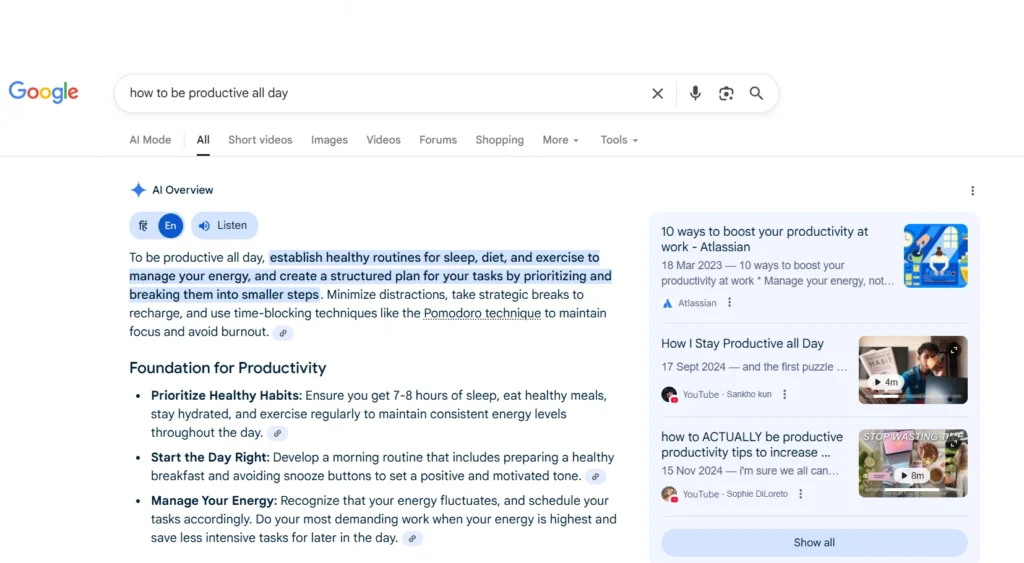
Google AI has revolutionised the way we interact with technology, offering thoughtful insights, automation, and powerful tools for both everyday users and digital marketers. If you’re exploring the Google AI overview, it’s easy to get lost in its features, from content suggestions to advanced analytics that can boost your SEO strategy.
However, not everyone wants AI-driven prompts to appear constantly. That’s why this guide also covers how to turn off Google AI overview, disable Google AI overview, and how to disable Google AI overview, giving you complete control over your Google experience while still harnessing the AI tools that matter.
Google’s AI Overviews, unveiled through the evolving Search Generative Experience (SGE), build upon innovations introduced during events like Google I/O 2025, where groundbreaking AI advancements were first showcased.
What Is Google AI Overview?
An AI overview is essentially a snapshot of how artificial intelligence is being utilised, developed, and integrated into various tools, platforms, and everyday technologies. Think of it as a quick guide that explains the capabilities, features, and potential of AI without diving into overly technical jargon.
When it comes to Google AI overview, this term often refers to Google’s own platform that summarises its AI technologies, research, and applications. It provides users with a clear understanding of Google’s AI initiatives, encompassing machine learning models, AI-powered tools, innovations in natural language processing, and advancements in computer vision.
For anyone curious about AI, whether you’re a business owner, developer, or simply tech-savvy, a Google AI overview provides an accessible entry point to understanding the possibilities and practical applications of AI in real life.
In short, an AI overview simplifies complex AI concepts, helping you gain a broader understanding of what AI can do and how it’s shaping the world around us.
Timeline of Google AI Overviews’ Rollout
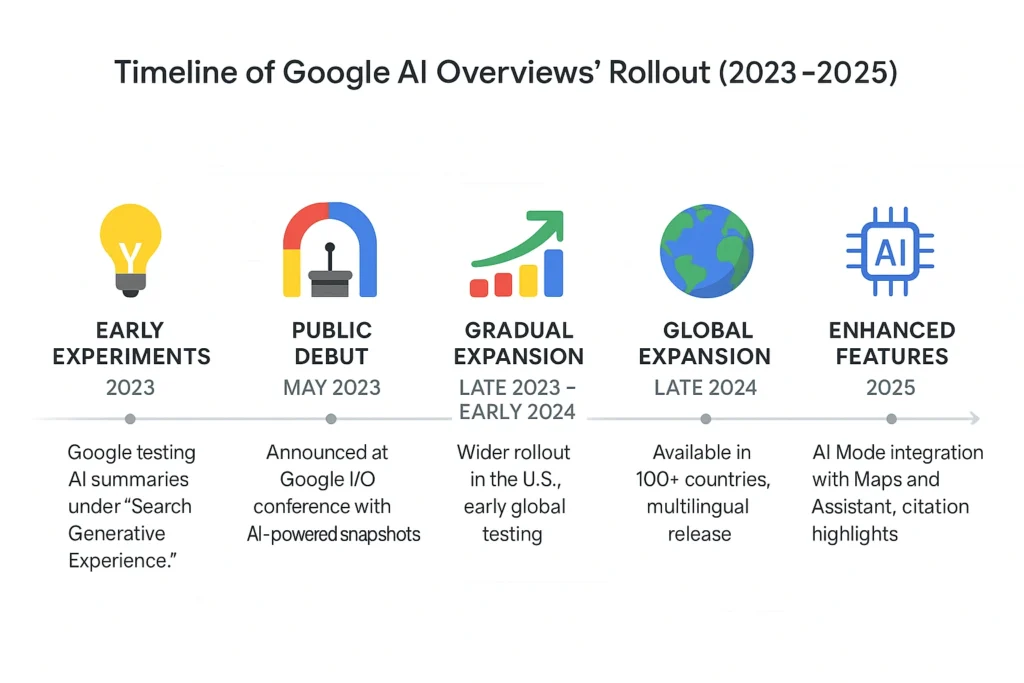
Google has been steadily reshaping the way we search with AI-powered summaries known as Google AI Overviews. These overviews aim to provide users with concise, informative answers at a glance, thereby reducing the need to scroll through multiple search results. Here’s a clear timeline of their rollout and evolution:
- Early Experiments (2023): In early 2023, Google began quietly testing AI-generated summaries within search results under the name Search Generative Experience (SGE). This phase was limited to a small group of users who signed up for the waitlist, providing Google with initial feedback on how AI could effectively summarise complex search queries.
- Public Debut (May 2023): Google officially unveiled AI-powered search summaries at the annual Google I/O conference. Early adopters were introduced to AI-generated snapshots of search results, showing Google’s vision for a more intuitive search experience.
- Gradual Expansion (Late 2023 – Early 2024): By late 2023, Google began rolling out AI Overviews more widely in the U.S. This included tests for users outside the original SGE waitlist, allowing everyday searchers to experience quick AI summaries directly on the results page.
- Official Launch & Rebranding (Mid-2024): At Google I/O 2024, the feature was rebranded as Google AI Overview, moving from experimental mode to a mainstream search tool. This rollout encompassed a broader audience and multiple topic categories, ranging from tech to lifestyle, providing a snapshot of content from various sources.
- Global Expansion (Late 2024): By the end of 2024, the Google AI Overview had become available in over 100 countries. Google also added support for multiple languages, making AI summaries accessible to a global audience.
- Enhanced Features (2025): In early 2025, Google introduced AI Overviews with an optional AI Mode, where summaries could be fully generated by AI, with citation sources clearly highlighted. They also began testing integration with other Google services, like Maps and Assistant, for a richer AI-assisted experience.
Why This Matters
The rollout of Google AI Overview is more than a feature update; it’s a shift in how we interact with information. Users can now quickly absorb key insights without having to sift through dozens of links. For businesses, it’s crucial to adapt SEO strategies to ensure visibility even when AI-generated summaries appear at the top of search results.
Why Google AI Overviews Matter More Than Ever?

Google’s push into AI Overviews isn’t just a small experiment; it’s a clear signal that the future of search is evolving. With initiatives like AI Mode, Google Search is moving beyond traditional results, offering smarter, faster, and more context-aware information.
Even today, Google dominates the global search market, and there’s every reason to believe it will continue to lead for years to come. Understanding AI overviews is no longer optional; it’s a way to stay ahead of how people will discover, interact with, and trust information online.
How Do Google AI Overviews Work?
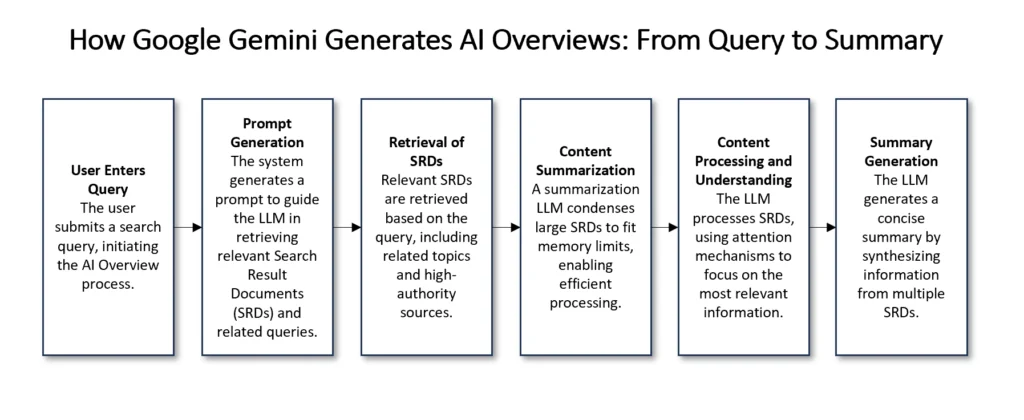
Google AI Overview is designed to make search smarter, faster, and more reliable by combining cutting-edge AI with fresh web data. Unlike traditional search, which only shows links and snippets, AI Overviews generate a concise, easy-to-read summary of the information you’re looking for.
At the core of this system is a method called retrieval-augmented generation (RAG). Instead of depending solely on pre-trained knowledge, which can sometimes be outdated or too general, Google AI Overview actively pulls the latest content from the web to craft accurate and relevant answers.
Here’s a simplified breakdown of how Google AI Overview works:
- Understanding Your Query: When you type in a question or search term, Google’s AI, powered by its LLM Gemini, analyses the context and intent behind your query.
- Fetching Relevant Data: The system searches Google’s index for related information. It also takes into account user behaviour, like which links are most commonly clicked for similar queries.
- Generating a Summary: Gemini synthesises the retrieved information into a clear, structured response. Often, this combines insights from multiple sources to provide a comprehensive answer.
- Citing Sources: Each AI Overview comes with clickable citations, a process Google refers to as grounding. This not only helps verify the information but also enables users to explore sources in greater detail.
- Learning from Feedback: Over time, Google AI Overview adapts based on user interactions. If users consistently engage with specific citations or skip the Overview for other results, future outputs are adjusted to improve relevance and accuracy.
In short, the Google AI Overview is more than just a summary; it’s a dynamic system that combines AI intelligence with live web data to provide you with precise, actionable answers in real-time.
How Do Google AI Overviews Impact the SERPs?
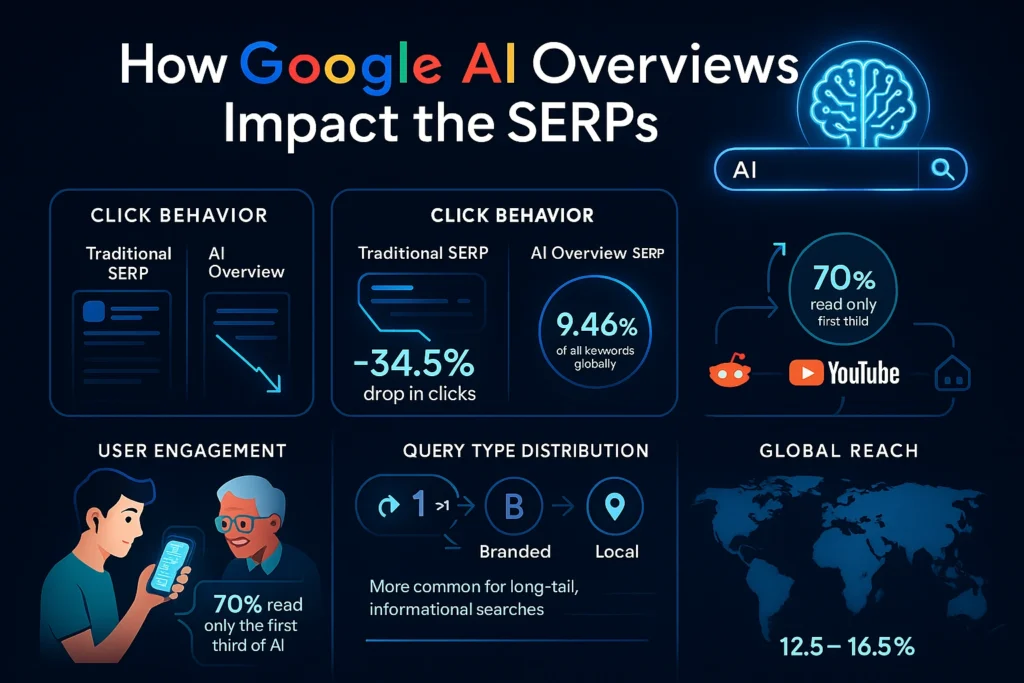
Google AI Overview has fundamentally changed the way search results are displayed, creating a shift in user behaviour and click patterns. Studies and data reveal some striking trends:
- Fewer clicks on traditional links: AI Overviews reduce clicks on standard results by about 34.5%, as users often find answers directly within the overview.
- Rapid growth: Since the March Core Update, AI Overviews have grown by 116%, showing Google’s commitment to this feature.
- Widespread visibility: AI Overviews appear for roughly 9.46% of all keywords globally, with desktop searches in the U.S. showing 16% coverage. By search volume, over 54% of queries may trigger an AI Overview.
- Global rollout trends: In countries where AI Overviews are active, they appear in 12.5–16.5% of searches.
- Domain concentration: An analysis of 55.8M AI Overviews reveals that the top 50 domains account for nearly 29% of all mentions.
- Query types: Overviews are more common for informational searches, longer queries, and high-volume topics. They appear less frequently for branded searches, local queries, and short-tail searches.
- User engagement: About 70% of searchers read only the first third of an AI Overview. Younger mobile users are more likely to engage with AI-generated answers and social proof, while older users still prefer traditional “blue link” authority sites.
- Traffic redistribution: Platforms like Reddit, YouTube, and niche forums capture roughly a third of the traffic that AI Overviews leave behind.
In short, the Google AI overview is not just a new feature; it’s reshaping how people interact with search results, who gets traffic, and how content strategies need to adapt.
How to Track and Measure the Impact of Google AI Overview?
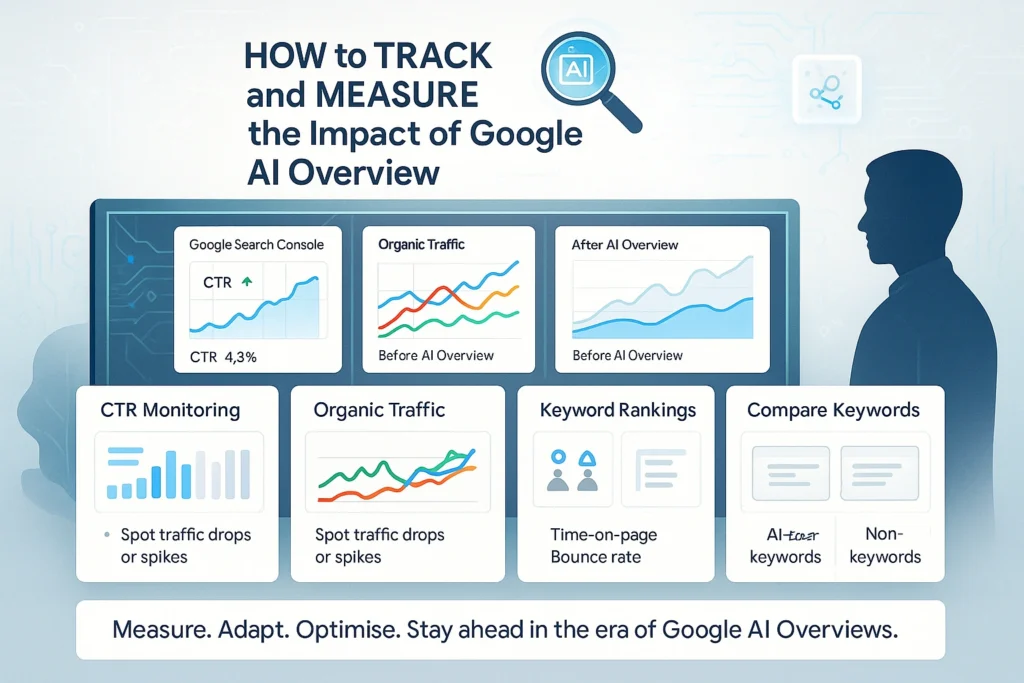
With the rollout of Google AI Overview, understanding its impact on your website’s performance is crucial. These AI-powered summaries can significantly impact how users interact with your content, so tracking their influence is essential in refining your SEO strategy.
Here’s how you can track and measure the impact effectively:
- Monitor Click-Through Rates (CTR)
AI Overviews often display summarised information at the top of search results. Track changes in your CTR using Google Search Console to see if users are clicking through your pages less or more. - Analyse Organic Traffic Trends
Keep an eye on traffic patterns to pages that appear in AI Overviews. A sudden drop or increase can indicate how AI summaries are affecting user behaviour. - Track Keyword Rankings
Utilise SEO tools to track the performance of your target keywords. Google AI Overview may alter search intent or highlight different content, so be aware of potential ranking changes over time. - Evaluate Engagement Metrics
Examine metrics such as time on page, bounce rate, and scroll depth. If users rely on AI Overviews, they may spend less time on your site, indicating a need to adjust your content strategy. - Compare With Non-AI Summary Keywords
Analyze keywords that don’t trigger AI Overviews versus those that do. This can help you understand which topics are more affected and where to optimise your content. - Use A/B Testing
Test variations of your content to see how AI Overview exposure impacts user engagement. Small changes in headlines or structured data can significantly affect whether your page is featured in the overview.
By systematically tracking these metrics, you can measure the real impact of Google AI Overview on your SEO performance and make informed decisions to stay ahead in search results.
How to Optimise for Google AI Overview?
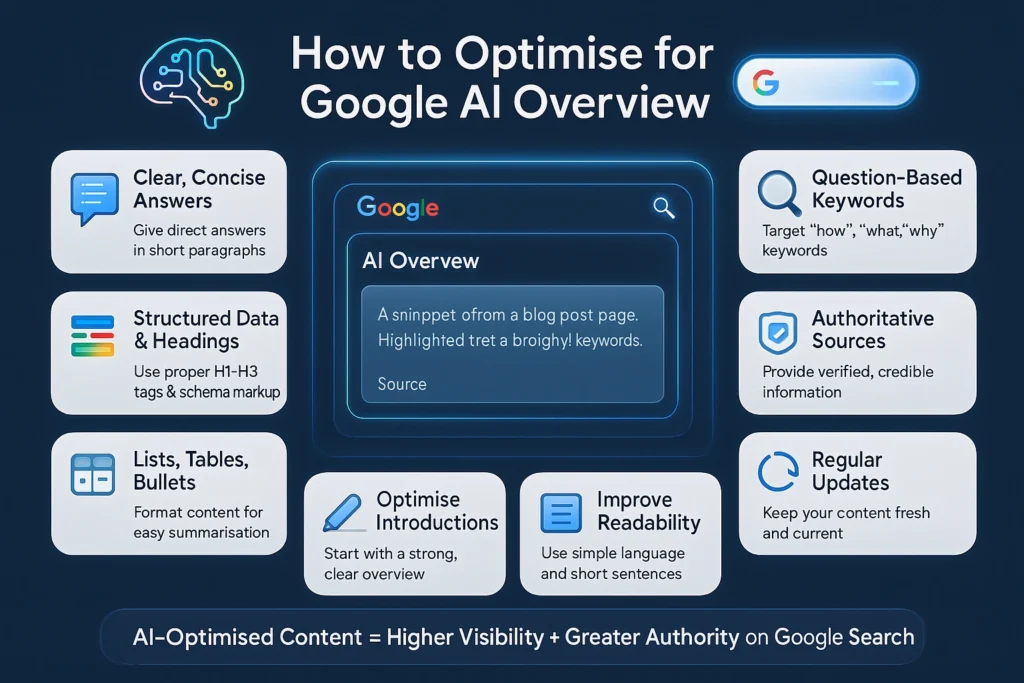
Google AI Overview often pulls concise, high-quality summaries from web pages to display at the top of search results. Optimising your content for this can improve visibility, traffic, and authority. Here’s how to do it:
- Focus on Clear, Concise Answers:
AI Overviews favour content that directly answers a user’s question. Structure your content with short, precise paragraphs or bullet points that get straight to the point. - Use Structured Data & Headings
Properly use H1, H2, and H3 tags, as well as schema markup. Clear headings make it easier for AI to identify your content’s key points and extract summaries. - Target Question-Based Keywords
Optimise for long-tail keywords and queries that start with “how,” “what,” “why,” etc. AI Overviews often surface answers to these specific questions. - Provide Authoritative & Reliable Information
Ensure your content is accurate, well-researched, and backed by sources. AI Overviews prioritise trustworthy content. - Use Lists, Tables, and Bullet Points
Summarizable formats like lists, step-by-step guides, or tables are more likely to be picked up by AI Overviews because they’re easy to digest. - Optimise Introductory Paragraphs
Write a strong, concise introduction that clearly defines the topic and provides a summary of the content. AI Overviews often extract text from the opening paragraphs. - Update Regularly
Keep your content current. AI Overviews prefer fresh, up-to-date information, especially for topics that are trending or evolving. - Improve Readability
Use simple language, short sentences, and avoid jargon. Clear writing increases the chances of your content being featured.
By implementing these strategies, your content becomes more AI-friendly, increasing the chances of appearing in Google AI Overview and capturing high-value visibility in search results.
Optimizing for Google AI Overview involves structured content, entity-based SEO, and clear headings. We’ve covered these techniques in detail in our blog on SEO for Google AI Overviews.
How to Turn Off Google AI Overview?
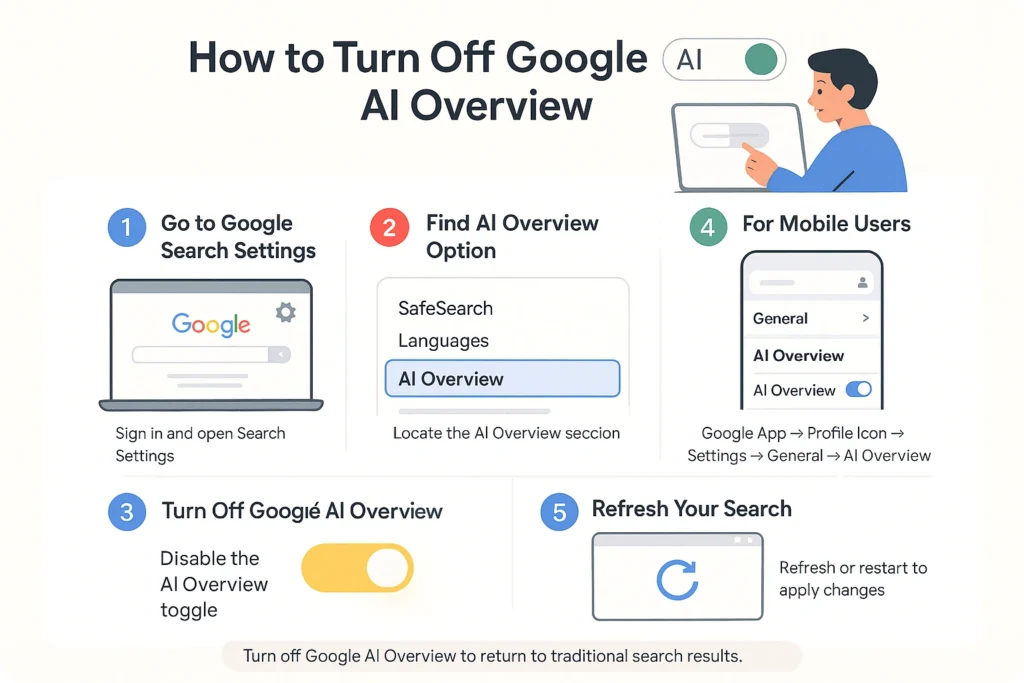
If you’re wondering how to turn off Google AI Overview, here’s a simple guide to stop AI-generated summaries from appearing in your search results.
- Go to Google Search Settings
Open Google Search Settings and make sure you’re signed in to your Google account. - Find the AI Overview Option
Scroll to the section labelled “AI Overview”, “Search summaries”, or “AI-powered summaries” (the label may vary by region). - Turn Off Google AI Overview
Toggle the option off to disable the feature. Don’t forget to save your changes at the bottom of the page. - For Mobile Users
Open the Google app → Tap Profile Picture → Settings → General → AI Overview → Toggle off. - Refresh Your Search
Clear your browser cache or refresh the Google app to ensure AI Overviews no longer appear.
By following these steps, you can easily turn off Google AI Overview and return to viewing traditional search results.
How to Disable AI Overview on Google?
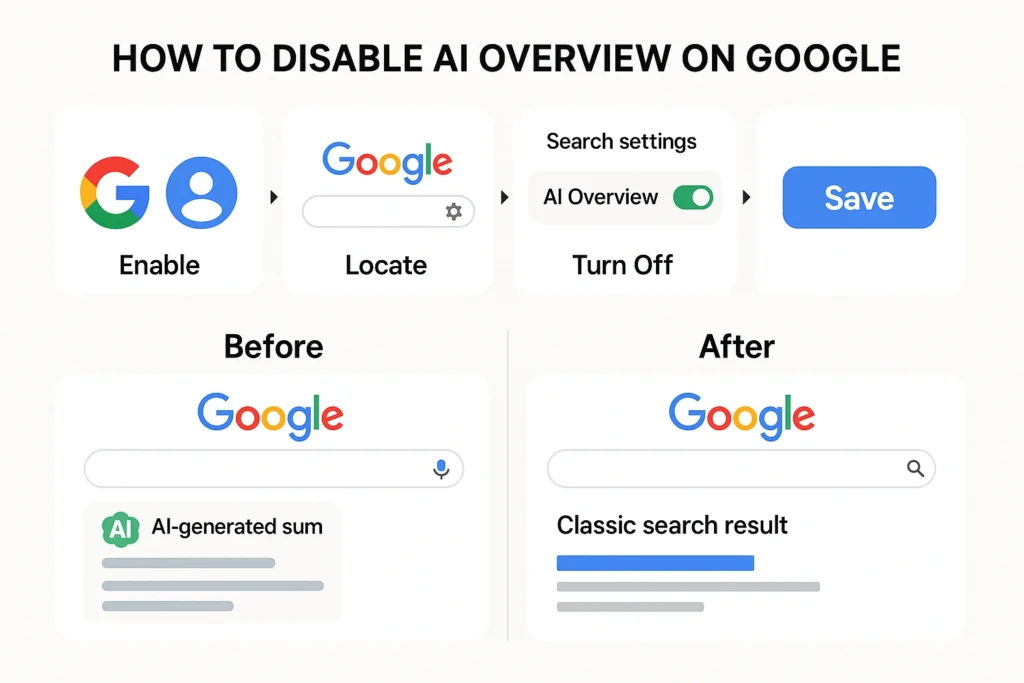
Google’s AI Overview is designed to give users quick summaries, insights, or highlights about search results using artificial intelligence. While this can be helpful, some users may prefer the traditional search experience without AI-generated summaries.
To disable AI Overview on Google, adjust your search settings. Typically, this involves:
- Opening Google Search Settings: Go to your Google account and navigate to search settings.
- Locating AI Features: Look for options related to AI-powered summaries or “AI Overview.”
- Turning Off the Feature: Toggle the setting off or uncheck the relevant box.
- Saving Changes: Be sure to save the settings so that your preferences are applied to future searches.
Disabling AI Overview gives you the classic Google Search experience, showing results exactly as they appear on web pages without AI-generated summaries.
How to Monitor Google AI Overviews?
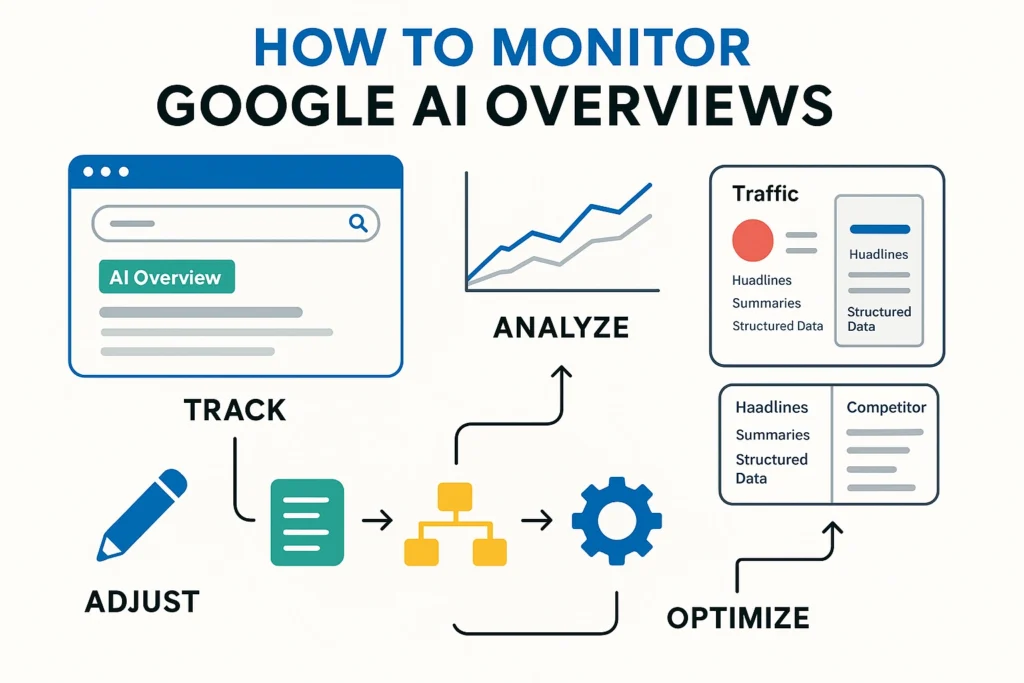
With the rise of AI-generated summaries in Google Search, known as AI Overviews, it’s crucial for businesses and content creators to monitor their presence and impact actively. AI Overviews offer users quick insights, which can impact click-through rates and organic traffic. Monitoring them helps you understand how your content is being represented in these AI summaries.
Why Monitor Google AI Overviews?
- Track Visibility: See if your content is appearing in AI-generated summaries.
- Measure Impact: Determine whether AI Overviews are reducing clicks to your website.
- Optimise Content: Adjust your content to increase the likelihood of being featured.
- Stay Competitive: Monitor competitors’ content in AI Overviews and identify potential opportunities.
How to Monitor Google AI Overview?
- Use SERP Monitoring Tools: Platforms that track search rankings are now integrating AI Overview tracking.
- Keyword Tracking: Identify which keywords trigger AI Overviews for your niche.
- Analyse Traffic Data: Compare traffic from pages featured in AI Overviews versus traditional search results.
- Content Strategy Adjustment: Optimise headlines, summaries, and structured data to align with AI Overview formatting.
Consistent monitoring allows you to stay ahead in SEO, maintain organic traffic, and leverage AI Overviews to your advantage.
What Are the Negative Impacts of AI Overviews on SEO?
While AI Overviews aim to enhance user experience, they pose several challenges for SEO:
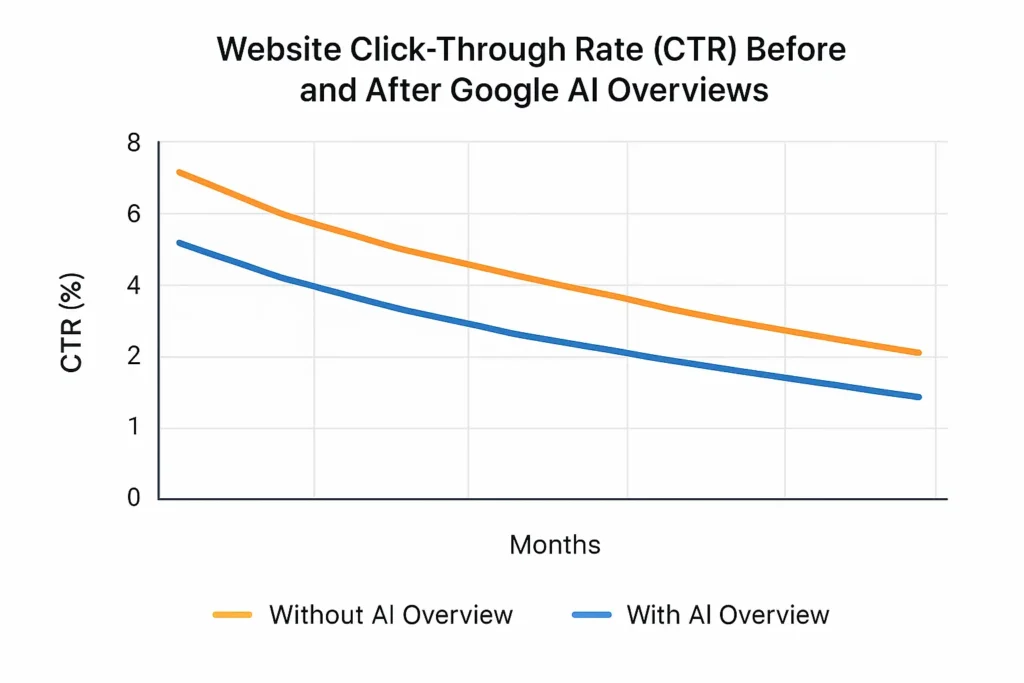
- Reduced Click-Through Rates (CTR): Users may find the information they need within the AI Overview, leading to fewer clicks on organic search results.
- Traffic Declines: Websites not featured in AI Overviews may experience a drop in traffic, especially for informational queries.
- Content Devaluation: High-quality content might be summarised without proper attribution, potentially diminishing the value of original content creators.
- SEO Strategy Shift: Traditional SEO practices may need to adapt, focusing more on content that aligns with AI’s summarisation criteria.
What Unique Features Does SE Ranking’s AI Overviews Monitor Offer?
SE Ranking provides specialised tools to monitor AI Overviews, offering features such as:
- AI Overview: Appearance Tracking identifies when and where your content appears in AI-generated summaries.
- Competitor Analysis: Compares your content’s presence in AI Overviews against competitors, highlighting areas for improvement
- Keyword Impact Assessment: Analyses which keywords trigger AI Overviews and how they affect your site’s visibility.
- Custom Reporting: Generates detailed reports on AI Overview metrics, aiding in strategic planning.
Adapting to the Future: Handling the Era of Google AI Overview
In conclusion, the rise of Google AI Overview marks a pivotal change in how search results are presented, making it essential for content creators and SEO professionals to stay informed. Understanding its impact and leveraging tools to monitor performance ensures content remains competitive and visible.
If Google AI Overviews shows what users see on the surface, Pomelli AI represents the quiet innovation happening underneath — where Google trains AI to think autonomously. Learn more about Pomelli AI
For users who prefer a more traditional search experience, knowing how to turn off Google AI Overview, disable Google AI Overview, or how to disable it provides the flexibility to navigate Google Search on their own terms. Staying proactive in this evolving landscape is key to maintaining relevance in an AI-driven world.